









“The job market changes but does not disappear”
This Article was written by Philipp C. Nell for the CEMS Report “The missing Rung? AI and the future of entry-level work.” Prof. Phillip Nell is a Chaired Professor at WU Vienna University of Economics and Business. He currently services as the Academic Director of WU Vienna’s program Master in International Management/CEMS.
For about a year I worried, like many, that AI would destroy many entry-level roles our CEMS graduates walk into. That no longer concerns me. Here are some of my thoughts. I write this as a researcher and lecturer at WU working on strategic problem solving and AI-augmented decision-making. I also build on my more recent experiences as a co-founder of an AI-native startup that focuses on building agentic automation for SMEs.
Dario Amodei, CEO of Anthropic, warned in mid-2025 that AI could eliminate up to half of entry-level white-collar jobs within five years, and a number of indicators demonstrate real effects on the job market due to non-negligible productivity jumps on all levels of an organisation. On the other hand, (agentic) AI still has a number of serious (and interrelated) problems such as hallucinations, contextual knowledge and understanding, model choice, geopolitics-influenced model access, and excessive (and very convincing) confidence. The costs of compute have also gone up leading to the outcome that – for many tasks – humans may (continue to) be cheaper that AI systems.
New kinds of roles emerge
Thus, while essentially all firms are experimenting with agentic AI and while there are some true effects, I do not believe that there will a massive shock on the job-market: it will change but not disappear. For example, the Frankfurter Allgemeine Zeitung, using Indeed data, just recently reported that German employers posted 288 new AI-focused job titles in the first quarter of 2026 alone – most of them outside the tech sector. What used to be a junior brand analyst producing weekly competitor reports shrinks into one task inside a bigger AI-managed workflow. Around that workflow appears another kind of role: someone who frames the questions, judges the outputs, coordinates the agents. Still market research, but not the same work.
For graduates the implication is straightforward and I am not worried about this part: get foundational knowledge of AI (what are the core mechanics that produce these outcomes) and then use AI a lot, in many different ways and forms.
Use AI seriously
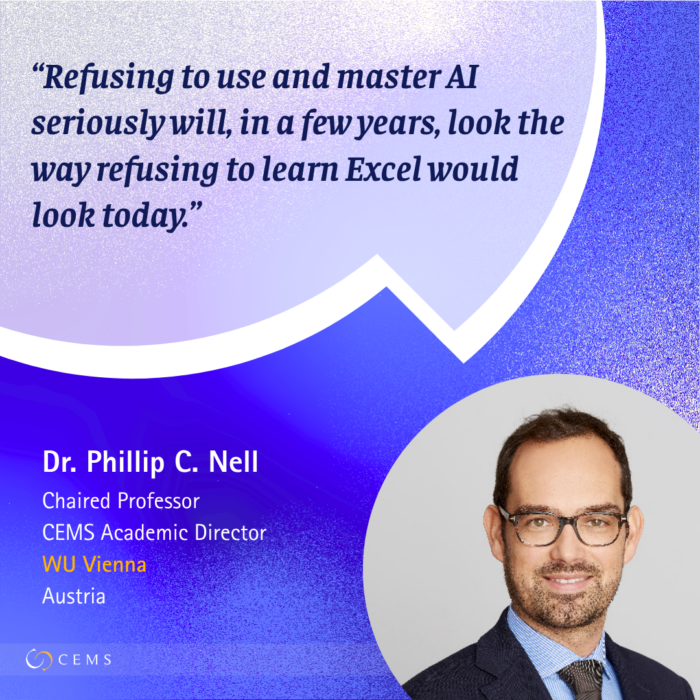
Learn what these systems do well and where they fail. In other words, try to figure out the jagged frontier of the systems (if you do not know what a “jagged frontier” is then this is one of the first things to look up). AI-skills will, by the time you finish your degree, be taken for granted by employers and they will increasingly be at the core of AI-related jobs. Refusing to use and master AI seriously during your studies will, in a few years, look the way refusing to learn Excel would look today.
Do not skip the fundamentals
However, there is also first evidence emerging that globally, social science students use AI in a suboptimal way. Cheating has gone up and, increasingly, many students use AI to produce content in a copy-paste way, especially in subjects in which they think they can get away with it easily. So far, this strategy works out for the most part because universities have not adapted fast enough. A recent study by Igor Chirikov of Berkeley found that, since the emergence of LLMs, the share of top grades increased much more in those courses that involve skills which LLMs are supposed to be good at (e.g., writing) compared to those which LLMs perform less well.
That creates a real danger: if AI agents change many jobs, they will also change the organisational processes around them – approvals, hand-offs, escalation paths, incentive structures – all of which will need redesigning once agents sit inside these workflows. Doing this well requires a real understanding of organisation design, process management, incentives, principal-agent problems, and so on. These are “boring” fundamentals of a business degree, but they will decide whether a firm’s AI adoption produces value or nonsense. Skipping this understanding because LLMs can produce well-graded stuff quickly, and without creating any real learning for the student, is not ideal.
Someone who has not properly studied the fundamentals cannot design agent-infused organisations well and cannot ask the right questions. And because AI problems also still persist in what could be named “factual knowledge”, not developing subject-specific fundamental knowledge and understanding will also disable students’ abilities to check, qualify, and correct AI output.
I try to deal with these issues in the following way: in my Strategic Problem-Solving course at WU I first cover key theoretical content without any AI, so that CEMS students work through theory and related case studies from scratch. Only later in the course do we discuss: where and how can AI be added to the mix? How can it sharpen my thinking and lead to deeper outcomes? Where does it fail and how would I know? We then try out AI-tools.
In summary
As a student, use AI a lot to upskill yourself and enhance your own original thinking, because this will be the future. Not using it is nonsensical. However, do not use it as a substitute for the fundamentals of your business education, because that does not really work. The graduates who will do well are those who develop both – a real understanding of core business concepts and mechanisms, and the skills to use AI properly, efficiently and effectively.
About CEMS – The Global Alliance of Management Education
CEMS is a global alliance where 33 leading business schools and over 70 companies and NGOs do something no one else does at this scale: they jointly build and deliver a Master’s in International Management.
One shared curriculum. One joint programme. Across six continents.
Students study at two or more universities across borders, work on challenges set by Corporate and Social Partners, and join a community that stays with them long after graduation. 23,000+ alumni still call themselves CEMSies and still mean it. Founded in 1988 on the belief that the world needs responsible and global leaders, CEMS has always been a bridge: between academia and industry, between cultures, and between knowledge and values.
Apply here to study CEMS International Management at WU Vienna!